logo logo logo logo
  • Home
  • About
    • About Mike
    • Military Background
    • Branding Ethos
    • Marketing Strategy
    • Gaming Philosophy
    • Personal Failures
    • Mentoring
    • Women’s Shelter
  • Companies
    • OMI Firm
    • Wolven Industries
    • Norton’s Gourmet
  • Investments
    • Dark Loch Studios
  • Adventures
  • Blog
    • Blog
    • Substack
    • Become Pen Pals
    • Content Calendar
    • Triggered?
  • Shop
    • Shop
    • Cart
    • Checkout
    • My account
  • Contact
  • Pieces & Memories

    of Norton's Mind

    1. Blog
    2. Pieces & Memories

My Gaming Philosophy

December 26, 2025
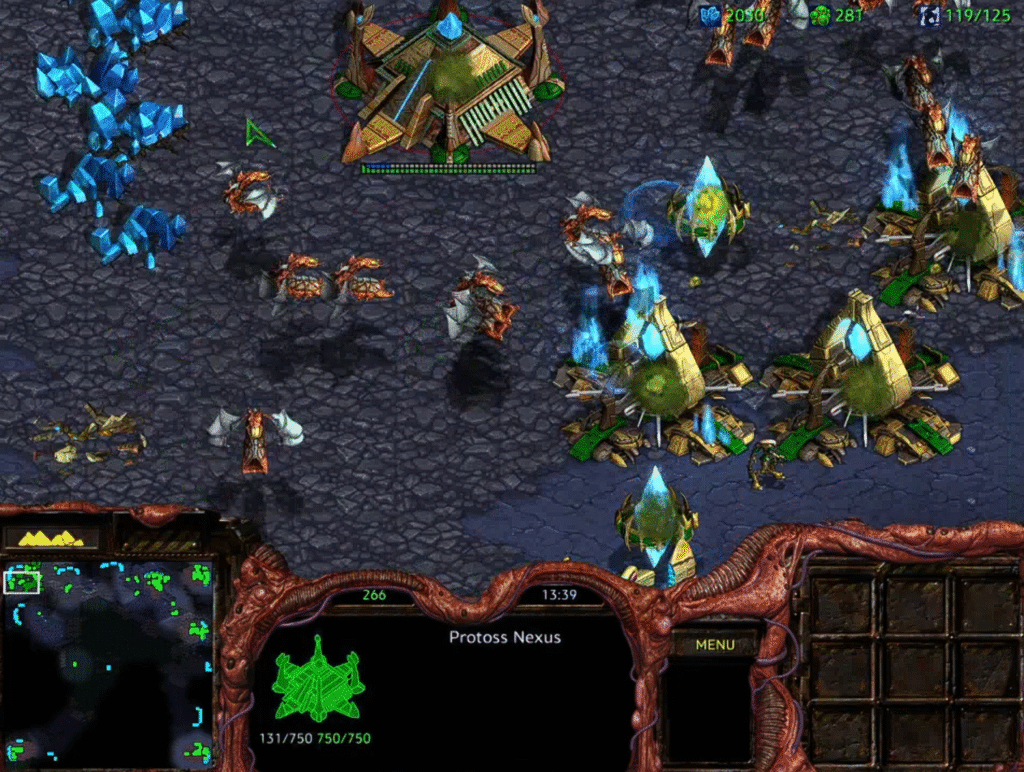
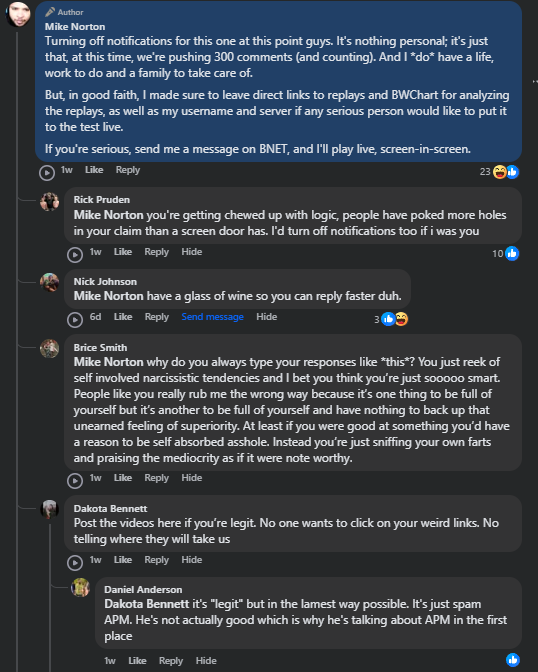
Me, playing StarCraft: Brood War

The Origins Of My Gaming Philosophy


At the time of this writing, I had been gaming in general for approximately 33 years, while playing Chess, inconsistently, for 22 years.

I had never competed in anything larger than a high school competition, held by only a handful of people. I had never won any major Chess awards, and never cared to.

In my high school, “Chess club” wasn’t really Chess club; it was “Gaming Club.”

It was officially classified as Chess Club, but we actually played everything from Chess, to Warhammer, to Yu-Gi-Oh. Sometimes, we played computer games on a LAN (local area network) and, on rare occasions, even brought in video-game systems like Nintendo 64s and Playstations while eating pizza together as a group.

During my time at Timber Creek Regional High School in Sicklerville, NJ (USA)…Chess Club was not a disciplined group with a focus on Chess. Chess was a game we genuinely liked and at least one game was played by somebody in the group every meeting but, as a whole, we only ever took it but so seriously. 

Chess simply wasn’t the gist of the club culture despite the name of the group, and this experience shaped how I looked at Chess, differently than many people in the world who make it a focal point of their entire identity.

Fast-forward two decades—I am a father. I work all day, and benefit from quick 5- to 20-minute games of high-paced, neurological activity to destress and reset my focus.

Chess becomes a fantastic way to do that. Chess and Starcraft: Brood War.

I started playing these old games again, several times per day, making breakthroughs in skill that I hadn’t experienced before when I was a teen.

I started posting casually online about it (click to read the original post), but ruffled feathers in a way I hadn’t expected.

While there were many supporters, I’d estimate the reception to be only about 45% supportive. The remaining 55%, technically the majority, were in a modality of ridicule and skepticism.

This made me very self-conscious at first, because I thought I had done something severely wrong.

Some people manipulated my words or, in good faith, only half-read my words.

Others made plausibly deniable racial statements, implying that someone who looks like me couldn’t possibly truly perform so well in such games because I allegedly lacked the IQ for them.

In response, I did not lash out, but posted one video at a time of my gameplay, along with supporting source files for the Internet to verify my authenticity.

To which, the sentiment changed from “He’s a liar,” to “Okay, he’s legit, but he’s not as good as he thinks he is.”

I insulted no one in my posts; I merely talked about my progress while calling for a partner. 

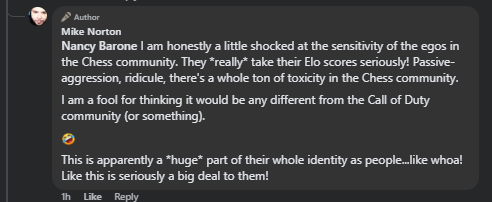
Yet, the passive-aggression, the name-calling, etc., in the comments were intense. 

Much of the crowd’s focus became about my ego, when I was just simply journaling publicly while looking for a continual partner to play either game with. 

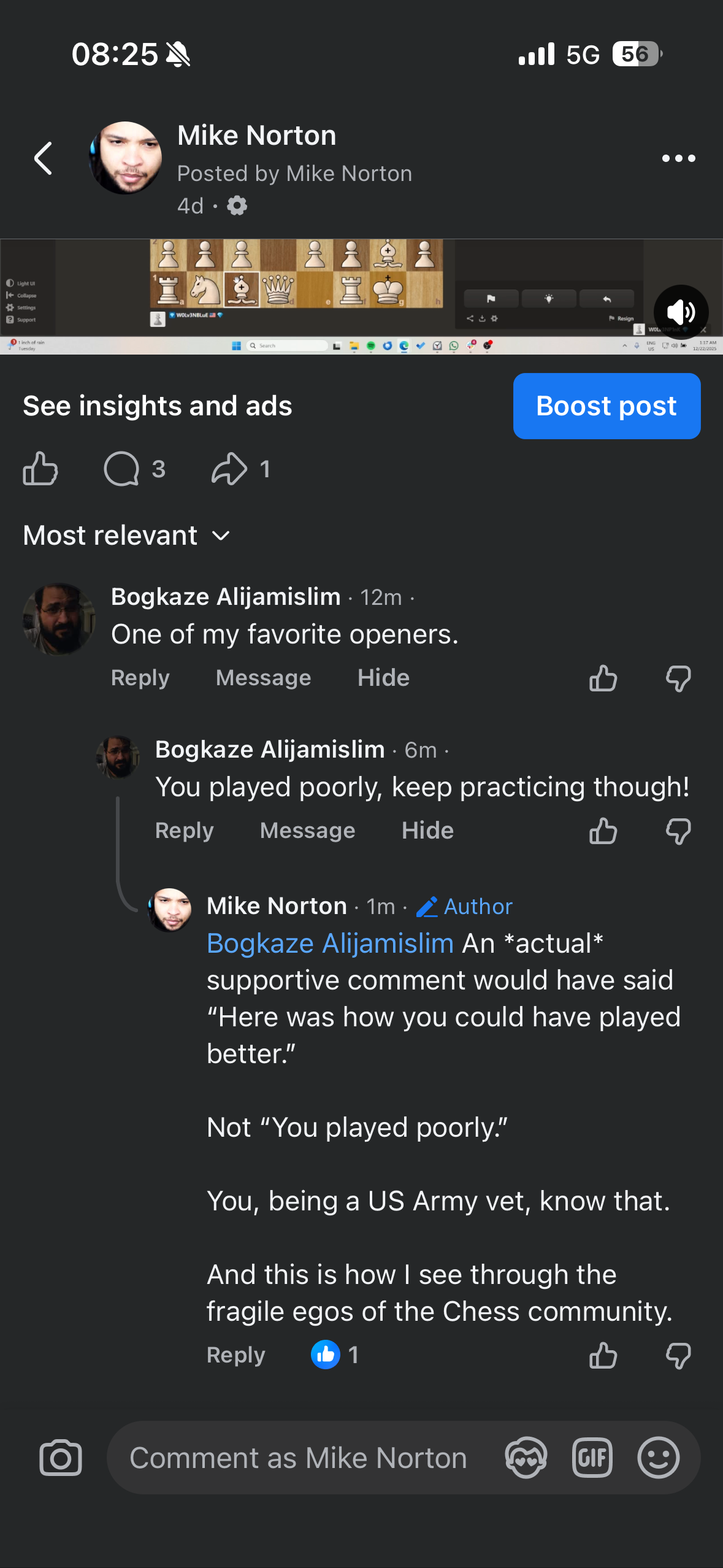
For example, in the screenshot above, a person criticizes my use of asterisks in my comments. My use of asterisks is simply a substitute for italicization, which the social media platform does not provide. Select italicization is good for voicing. That person’s criticism was personal, had nothing to do with my gaming, was completely unrelated to the topic of the post, and you can tell that by their use of “why do you always” they had been following me for a while…just waiting for a crowd’s approval to pounce—instead of just speaking their mind in general.

For another example, in the same screenshot, a gamer concedes that I had been telling the truth; he just began criticizing the legitimacy as lame. In reality, however, my gaming was either legit or not; I either lied or I didn’t—the rest is subjective and relative.

I chose this approach to seeking a partner because it worked before to find someone really skilled in StarCraft in a way that led to me having more fun than I have had in years. I wanted that experience again. Didn’t matter so much from whom, and it didn’t matter whether I won or lost.

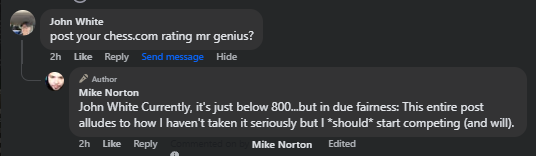
To avoid playing the victim, I took responsibility for whatever I could have done better to improve my communicative delivery and apologized for what was reasonable to in the comments. I catalyzed the backlash by posting about my progress in Chess and Starcraft in a way that came off as narcissistic; instead of leading off with just posting the videos and source files and letting those speak for themselves.

While I did eventually do that, by that point, my communicative delivery was all screwed up. This is what I apologized for. In this context, I am not a victim.

However, there was indeed a point at which people really were twisting my words, willfully ignoring substance, context, etc., villifying me without any charity in a way that manifested into a certain percentage of genuine, egoistic toxicity projected from the crowd that wouldn’t make sense for me to apologize for.
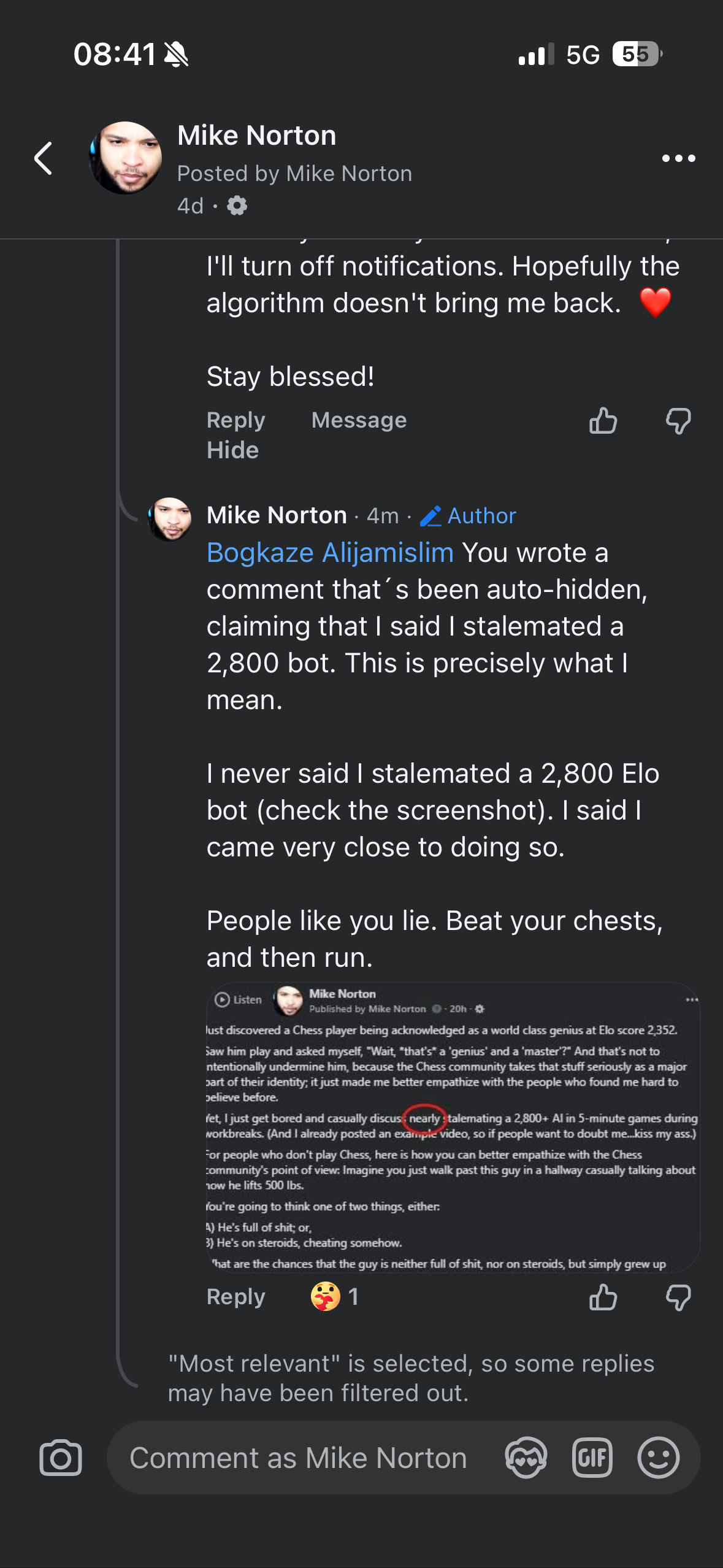
As of this writing, I am still mentally processing how much games like Chess mean to some people’s identities, and how defensively reactive they are in efforts to preserve those identities.

…while someone like me has never really cared that much. At all.

Until this incident.
Did this negative social experience deter me from playing?

Negative.

Not in the slightest because, more objectively: 

  • I did not lie about either my StarCraft or Chess gameplay.
  • I did not fabricate evidence or doctor my replays.
  • I saved and provided replays for verification.
  • I provided standard analysis tools (BWChart) instead of hiding behind screenshots.
  • I invited falsification through open 1v1 challenge (which nobody answered), not blind belief.
  • I answered good-faith questions directly.
  • I didn’t delete any posts or comments to avoid scrutiny.
  • I never attacked anyone personally, even while being mocked.
  • I disengaged once the discussion turned into a collective dig at my ego (what I could tell was the crowd’s true ire) rather than the objective reality of my gaming and the good intent behind my posting.

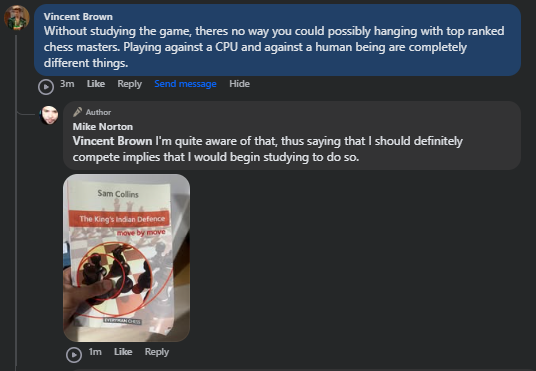
Instead, it inspired me to get into competitive gaming the way I was interested in it as a teen.
My Gaming Philosophy

Competitive gaming is a serious endeavor. 

So, if I am to do this, I have to think of how to do it in the way that’s right for me.

I have had to think about the why and what outcome I would like to optimize for, because there is no end to it. 

  • There is always a higher Elo score (or equivalent per game ladder) you can get. 
  • There is always another tournament to participate in. 
  • There will always be another trash-talking opponent. 

You are not your score.

This video I filmed, in which I taught my son how and why to win particular missions in a war game without killing anyone (even though the game rewards you for doing so), long before I wrote this post, shows how I have evolved to think about things like “scores.” 

And, in good faith, take into consideration how this video was filmed long before there was any backlash against me.

This is truly how I think; it is not what Nietzsche would refer to as cowardice masquerading as moral high ground: I genuinely do not value scores more than I value character.

Like IQ scores or the numbers of your bank account, things like Elo scores, kill counts, etc. matter in their own way in their own contexts; yet, they are not measurements of a life’s intrinsic value itself. 

Scores correlate with skills applied to certain arenas, but none are readings of character. They are not readings of whether you are making the world a better place or living a life of any significant meaning.

When you die, will anyone ever actually remember your Chess Elo score? Will anyone ever remember your top killing spree score in Halo or Call of Duty?

Even if you gain the highest score, in any game (pick one), ever recorded in human history…it would be relegated to little more than a forgettable factoid within a week because people don’t care as they live their day-to-day lives in the grand scheme of human society.

And why should they? What does the accomplishment of any given score in any given game or test really mean for the world and people’s lives?

Nothing.

I had been traveling around the world for nearly 20 years of my 37 total years of living before I even knew that Elo scores even really meant anything. 
You are not any particular victory or defeat.

I love a good challenge for the thrill of it.

Win or lose, a proper challenge helps me ascend into flow state, and flow state is a natural, healthy high that eases psychophysiological pain of post-traumatic scarring.

So, what does matter in gaming? For me, it is the continual betterment of self as transferable in other areas of life.

Gaming, especially at a high level, is one of the last frontiers where you can practice complex decision-making under intense cognitive demand without real-world stakes. 

It’s safe war. Simulated risk.

And for someone like me (someone whose life has been shaped by very real forms of danger, pressure, and travel) it becomes a form of meditation.

The Mission

With this developing philosophy in mind, competitive gaming, to me, is a complementary sub-mission of my overall life mission.

In my mind, it all aligns. 

My mission in gaming is to continually push myself to higher and higher levels of self-actualization while sharing the fruits of that character development in the form of philosophical content that inspires the viewer to make the world a genuinely better place through becoming better people.

My mission in competitive gaming is to inspire my audience to make the world a genuinely better place through learning by both my words and example how to become better people despite natural flaws. 

I intend to accomplish this mission by documenting how I push myself to higher and higher levels of self-actualization through the world of competitive gaming’s challenges, regardless of whether I win or lose any particular bout…because one can learn how to be an increasingly better person from either. 

  • How should one reach for their contextual greatness?
  • How should one respond to difficulty?
  • How should one behave when they lose, and why?
  • How should one behave when they win, and why? 
  • How should one handle being criticized, doubted, and/or laughed at, and why?
  • How should one learn, when there’s no reward for it but one’s own growth? 
  • How does one gain increasingly deeper levels of self-understanding and, through such self-knowledge, gain a more profound understanding of the world?
    • How does one then use that ever-improving understanding of the world to make it a better place?
  • How does one continually self-actualize into increasingly better versions of oneself, especially increasingly better versions of oneself that bring value to other people’s lives, particularly their family’s?

These are the real questions that I have found continually evolving answers for in gaming, and they are infinitely more interesting than the scoreboard.

And the point of my competitive gaming journey, as documented hereafter, is to share them.

How Is This Possible?

Most gaming videos will be focused on short 5-20 minute games I can play during the workbreaks of my other endeavors. I will utilize screenrecording software to save the video, then later edit the video with voice-over and other footage that yields enjoyable, thought-provoking content to whatever audience is receptive to it.

Here are several examples:

  • The Importance Of A Muse Over A Porn Star
  • What I Learned About Protecting My Children From Pedophiles After Being Away For 3 Months
  • “You are only feeding your inner psychopath” — Real Veteran Father Teaches Son Why To Win Without Killing

This way, everything I do, even the breaks I take, can be valuable to someone else, even if only one other person in the world.

Mike Norton

Just a student of life who has been around here and there. Everyone is my teacher.

Site
  • Home
  • About
  • Adventures
  • Blog
  • Contact
Companies
  • OMI Firm
  • Wolven Industries
  • Norton's Gourmet
Contact
  • E. michael@nortonsmind.com
  • T. +1 856 295 1017
Message
Enter Your Darkest Cave

Sign up for thought-provoking e-mails that raise questions about life, fatherhood, overcoming struggle, and individuating your shadow as you face your darkest fears with stories of Mike's personal experiences.

[sibwp_form id=2]
Copyright © 2025, Norton's Mind.